

This week at Cog #31
Wartime comms, a ‘microcosm’ of America, driving with autism and bookmark relics

Most people don’t realize that WBUR’s office is in the heart of Boston University’s campus. (We’re one of several public media outlets whose licenses are held by a university — in our case, BU.) Practically speaking, this means going to the office kinda feels like going to college. There are always tons of young people lugging backpacks across Comm. Ave., trying to dodge (or catch) the T.
It also means our neighborhood has a very seasonal rhythm. It still feels like early spring in Boston. Cool, rainy, daffodils and very few leaves on the trees just yet. Students are preparing for finals. In a few weeks, my colleagues and I will groan about the inconvenience of commencement ceremonies (with too many people clogging up the sidewalks to celebrate their graduates). And then, poof. The majority of students will be gone for the summer and our bustling corner of Boston will be a whole lot quieter for a while.
Do anything for long enough, and you start to notice patterns. And how quickly the years tick by. I’ve been thinking this week about how much can happen — and change — in a single year, despite these rhythms. I went to see the author Patrick Radden Keefe at WBUR’s CitySpace this week (he’s on tour promoting “London Falling.”) He talked about his new book, of course, but also about how his attention span has changed over the years — and how that’s changed him as a reader and a writer. Keefe is a master of the craft, and revered for his ability to structure incredibly complex stories in a way that makes his work read like a propulsive novel. He always manages to find a surprise, a twist — because, he says, that’s how life is. Our existence can be seasonal and predictable, but really, who knows what’s next? — CA
This week’s stories

A Band-Aid, a Trivial Pursuit card, postcards from 1931 Berlin: All evidence of our shared humanity
In Kate Peltz’s public library, there’s a box of lost relics that people once used as bookmarks. “Sifting through the dusty pile felt like being in on a delicious secret or traveling down a hidden passageway into a forgotten world,” writes Peltz.
The Blue Envelope Program protects police officers and autistic drivers. Let’s make it law
In April 2024, the Massachusetts State Police rolled out a voluntary Blue Envelope Program to protect autistic drivers and officers. But the program must still be codified into law to ensure its longevity and because the envelopes are meaningless if someone drives through a city or town that is unfamiliar with the program, writes Ilyse Levine-Kanji.
What wartime communication can sound like
“Wartime communication is not a branding exercise. It is not a press conference or a social media post,” writes Stuart N. Brotman, the former president and CEO of The Museum of Television & Radio.
Old North Church is a ‘microcosm of America as an unfinished work’
The mood in Boston in April 1775 was bleak and uncertain. The city was under military occupation, and division over the best path forward pitted families, friends and neighbors against each other, writes Nikki Stewart. The lanterns hanging in the Old North Church didn’t mean a swift victory or a unified nation; they called for courage, community and hope.
Bonus content
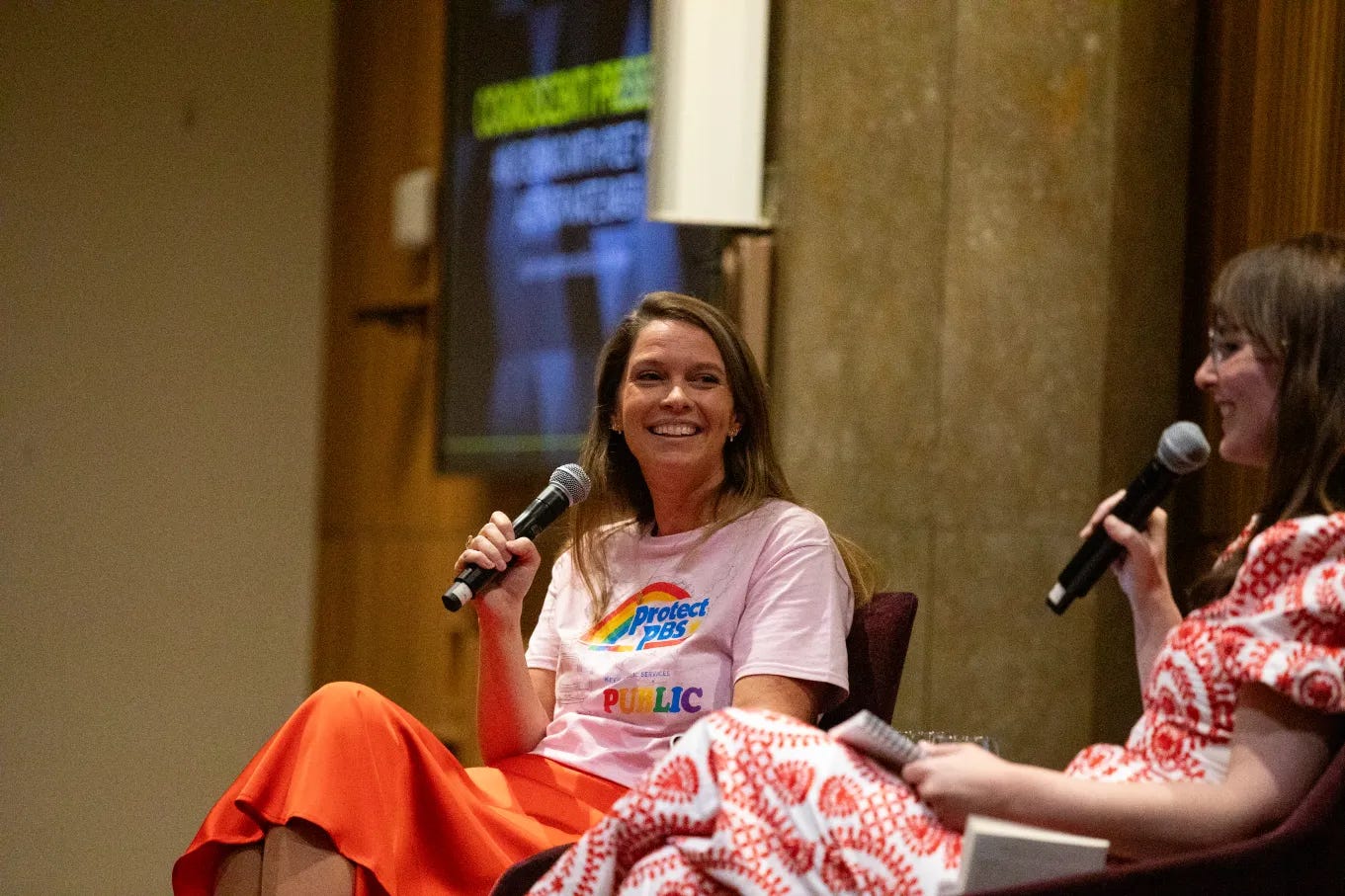
Kate Baer has always been a writer
In honor of National Poetry Month, we’re resharing this story about poet and friend of Cog Kate Baer. When Baer got pregnant, unexpectedly, with her fourth child, something shifted. “I had this decision to make,” explains the best-selling author. “Am I going to drown — lose my life — or am I going to completely change everything?”

Lena Dunham of “Girls” fame is everywhere this month. Her new memoir, “Famesick,” was released on April 14, and she’s been making the rounds to promote the book. I’m one of those people without a generation— too young to be Gen X, too old to be a Millennial— but I watched “Girls” when it came out, and seeing Dunham back in the news is making me want to do a rewatch. Read her delightful New Yorker piece, “How I became a filmmaker,” here.
On Tuesday night, our colleague Here & Now senior managing editor Todd Mundt moderated a conversation with writer Patrick Radden Keefe about his newest book, “London Falling: A Mysterious Death in a Gilded City and a Family’s Search for Truth,” an investigation into the death of 19-year-old Zac Brettler, who had been living a dangerous double life unbeknownst to his family. Watch the recording of their conversation here.